Temporal in Ten Minutes
Learn how Temporal makes distributed systems easier by handling fault tolerance, state persistence, and workflow orchestration automatically in just ten minutes.

Mario Guerra
Author

Picture this: it is 2 AM and your e-commerce checkout system crashes mid-transaction.
Without the right safeguards, customers could be left with pending payments. Your database could end up in an inconsistent state. And your monitoring system is about to turn a quiet night into an incident response exercise.
What do you do?
If you are using Temporal, the answer is: nothing.
Temporal can recover the workflow state and continue from the point where the process stopped. No starting over. No guessing whether a charge happened. No manually reconstructing a transaction from logs at 2 AM.
The promise
Write the business process you want to happen. Temporal persists its progress, coordinates the work, and gives it a path forward when infrastructure fails.
That is the practical appeal of Temporal. It isn't magic, and it doesn't make distributed systems painless. It does make a hard, repetitive category of work much more manageable.
What is Temporal?
Think of Temporal as a coordinator for business processes that need to complete reliably. It is a durable execution platform: your workflow code describes the process, while Temporal records the history needed to resume it after failures, deployments, timeouts, or long waits.
The mental model that made it click for me is Git for workflow execution.
| Git | Temporal |
|---|---|
| Stores code commits | Stores workflow events |
| Recreates a repository state | Recreates a workflow state |
| Lets you inspect how code changed | Lets you inspect what a process did |
Git can reconstruct a codebase at a particular point in time. Temporal can reconstruct a workflow at a particular point in its execution. When a worker crashes, Temporal does not ask the next worker to guess where things left off. It gives the worker the event history it needs to continue.
That is why Temporal is useful for work that spans multiple services, calls external APIs, or runs for hours, days, or months.
Why should you care?
You can write retry logic around a single HTTP call. The real complexity begins when one business process crosses several systems.
Consider an order workflow:
Every step can fail independently. A network timeout does not prove that the remote service did nothing. A service can restart after it completes work but before it records the result locally. As these workflows grow, so does the custom code for state management, retries, and operational recovery.
Temporal keeps the process state durable and gives each step a defined execution model. Failed work can retry according to a policy. A workflow can wait for a signal, a timer, or a human decision without holding a server process open. If one worker disappears, another can pick up the work.
The failures do not disappear. They become something the application can model, observe, and recover from deliberately.
The building blocks
Temporal becomes much easier to reason about when you know its four main pieces.
Workflows
The durable definition of a business process: what happens, in what order, and under what conditions.
Activities
The work with side effects: API calls, database writes, messages, and payment charges.
Workers
Your application processes. They poll task queues and execute workflow and activity code.
Temporal service
The coordination layer that records workflow history, schedules tasks, and tracks progress.
Workflows must be deterministic
A workflow can coordinate activities, timers, signals, and child workflows. But when Temporal replays its history, the workflow needs to make the same decisions from the same inputs. That means workflow code should not make unrecorded network calls or base a decision on a changing value such as the current time.
Activities need to be safe to retry
Activities are where side effects happen, and Temporal can apply retries and timeouts to them. Make them idempotent whenever possible. If an activity might charge a card or create an external record, use an idempotency key or another strategy that makes an ambiguous retry safe.
A useful rule of thumb: workflows coordinate; activities do the work.
How recovery actually works
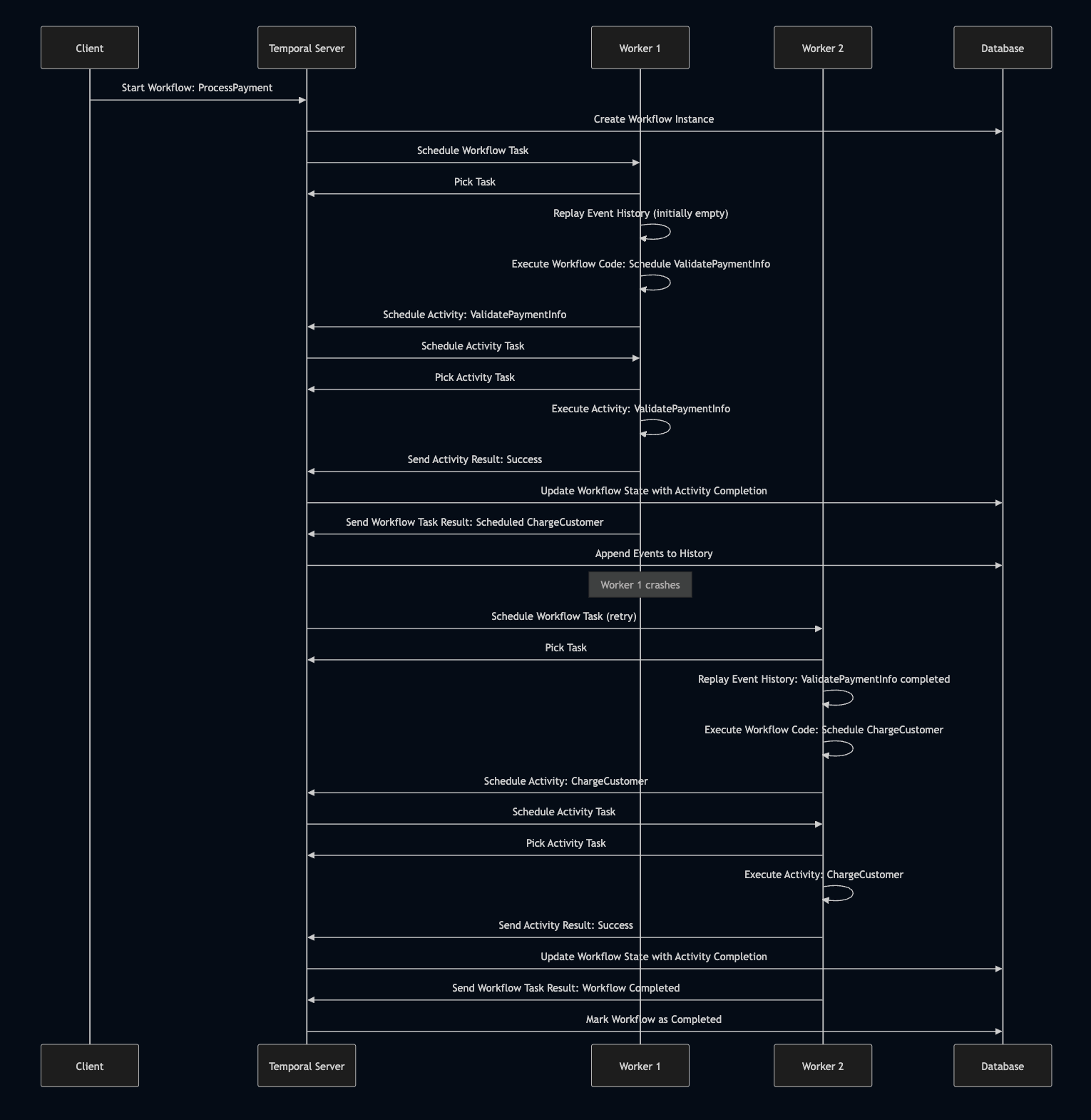
Suppose a worker validates a payment and then crashes before it starts the charge. The validation result is already in the workflow history.
A new worker receives the task and replays the workflow code from that history. The workflow may look as though it is running from the beginning, but Temporal returns recorded results for completed work rather than performing those activities again. When it reaches the first unfinished step, it schedules the real work and proceeds normally.
A worker handoff in five steps
- The first worker validates the payment.
- Temporal records the result in the workflow history.
- The worker fails before it can charge the customer.
- A second worker replays the history and receives the saved validation result.
- The workflow starts the charge because it is the first unfinished step.
The same model is what makes long-running workflows practical. A workflow can wait for a shipment confirmation, a customer response, or a timer that lasts weeks. No worker stays open during the wait. Temporal records the pending state and creates a task when the workflow is ready to continue.
A simple payment example
Let us go back to the payment flow:
- Validate the payment information.
- Charge the customer with an idempotency key.
- Send the receipt.
In a traditional system, a crash after step two but before step three creates an uncomfortable question: did the customer get charged? If the service restarts blindly, it may charge them again.
With Temporal, the completed charge is in the workflow history. After recovery, Temporal replays the workflow, returns the recorded charge result, and continues with the receipt.
The important caveat
Temporal can retry an activity; it cannot make a non-idempotent payment provider safe by itself. Durable orchestration still needs to be paired with well-designed external APIs and clear business rules.
Why developers like it
The biggest shift is not that Temporal removes complexity. It changes where that complexity lives.
Instead of scattering state transitions across queues, cron jobs, database flags, and retry handlers, you can express the business process in one workflow. You write ordinary application code in an SDK-supported language, while Temporal handles the durable coordination around it.
The practical benefits are straightforward:
- Workflow histories show the state and past decisions for a process.
- Retries and timeouts become part of the workflow model.
- Long-running work does not depend on one server staying alive.
- Tests can exercise workflow decisions independently from activity implementations.
- The Temporal Web UI provides a direct view of workflow history and failures.
That last point matters more than it sounds. Debugging a distributed process is much easier when you can see what happened in sequence instead of piecing it together from logs across several services.
Getting started
Start with one process where failure handling is already expensive or fragile: payment flows, account provisioning, order fulfillment, document processing, or approvals are all good candidates.
Pick an SDK for the language your services already use: Go, Java, Python, TypeScript, or .NET. Build a small workflow with one or two activities, define explicit timeout and retry policies, then test a failure path before expanding it.
Final thoughts
Temporal is not a shortcut around good distributed-systems design. It is a foundation for it.
For processes that need to survive unreliable networks, service failures, and long waits, it gives you a durable record of what happened and a reliable way to continue. That means fewer 2 AM investigations and more time spent on the business behavior your system is supposed to deliver.